I was about ten when I caused my first major diplomatic incident.
An aunt was visiting, which meant Nigerian hospitality mode: food was being prepared, people were being fed, and nobody was leaving with the impression that we had merely tolerated them.
I was assigned the final mile of delivery.
My mother handed me a plate containing a steaming mountain of jollof rice. I carried it toward the living room, mostly thinking about the video game I had paused.
What I did not notice was that the piece of goat meat intended for the plate had been set aside on the kitchen counter.
I placed the rice in front of my aunt.
The conversation did not stop so much as evaporate.
My mother looked at the plate. Then she looked at me.
If you have never seen a Nigerian mother realize that her child has served an honoured guest a vegetarian meal by administrative error, the face combines betrayal, alarm and the sudden suspicion that she may have raised an anarchist.
I had not just brought my aunt carbohydrates. I had apparently delivered a formal declaration of disrespect.
I was intercepted. The plate returned to the kitchen. The goat meat was placed on top like a crown. The natural order of the universe resumed.
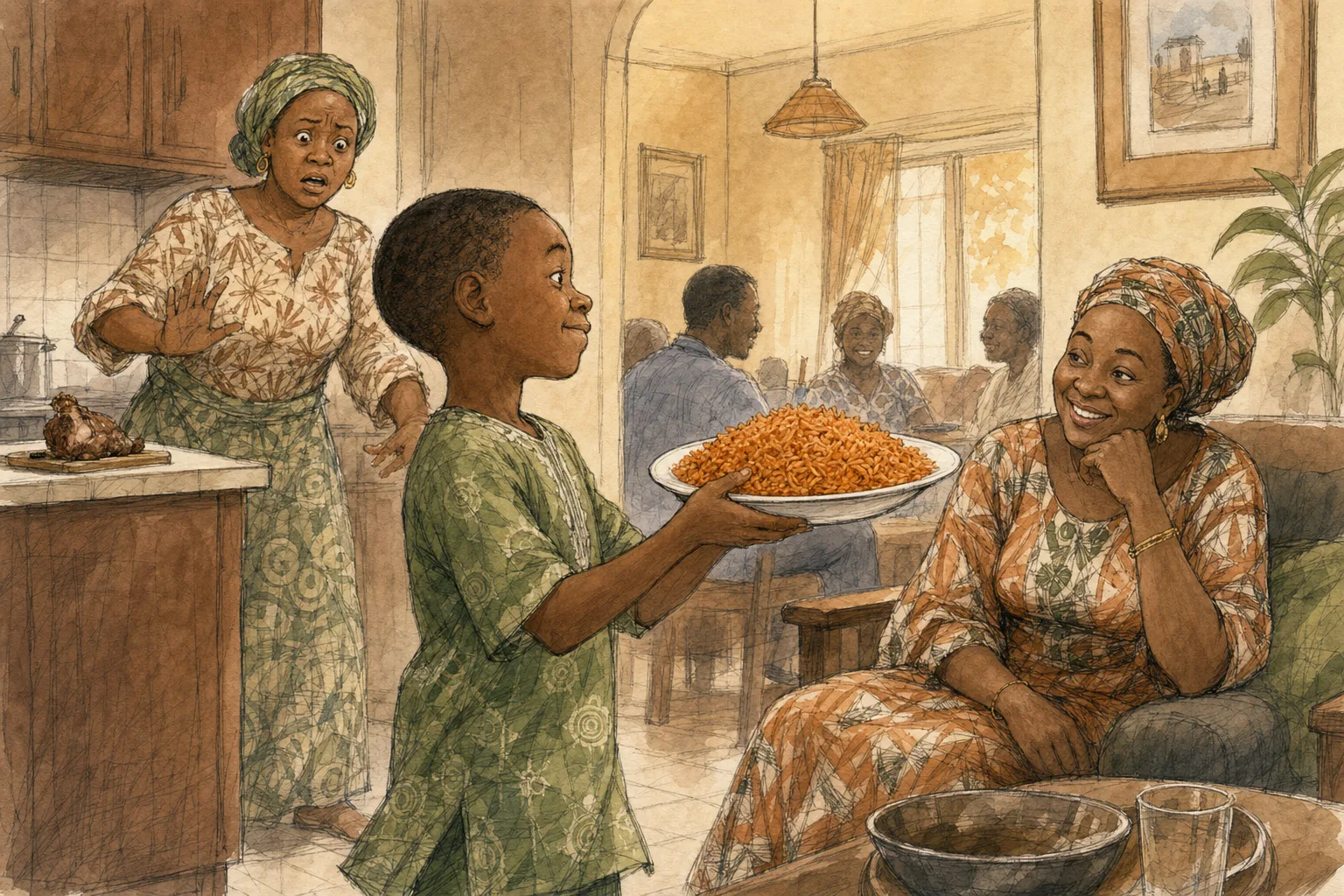
I remember being confused.
The rice was delicious on its own. Why had a missing piece of meat become an emergency?
Ten-year-old me wanted a technical specification.
What is the required meat-to-rice ratio for a guest?
What happens if the guest is full?
Is there an exception process?
Nobody paused to give me the documentation. They just fixed the plate.
Years later, I think that moment contains a better question than my childhood complaint:
When a rule feels obvious to everyone except the child who broke it, what exactly is the rule carrying?
The goat meat was not merely goat meat
It is tempting to reverse-engineer the whole scene into one clean explanation.
Perhaps animal protein was scarce or expensive. Perhaps serving it showed that a host was giving a guest something valuable rather than merely filling space on a plate. Several versions may contain truth.
But I do not know enough to claim that one missing piece of goat meat reveals the origin of Nigerian hospitality. Nigeria contains many peoples, histories, cuisines and household traditions. A rule in my family is not a national archaeological finding.
Even food-sharing research does not offer one universal explanation. Food can reduce risk, build reciprocity, signal generosity, establish status or create obligations—and the same meal can do several of those things at once. (Gurven, 2004)
The safer claim is personal.
In that room, the meat did more than provide nutrition.
It made care visible.
The plate said:
You are not receiving whatever happened to be available.
You are being honoured.
Another ingredient, extra effort, the best seat or my mother refusing to let anyone leave hungry could have carried the same message.
The goat meat was the rendering of the message in that house.
Culture is a very efficient compression algorithm
Imagine trying to pass the full rule to the next generation:
When someone enters your home, make their importance tangible. Offer them more than adequate calories. Let the meal communicate welcome, generosity and regard in a form they can immediately recognize.
That is lovely—and too long to shout across a kitchen while a ten-year-old escapes toward a video game.
So the rule compresses:
Put meat on the guest’s plate.
Compression is one of culture’s superpowers.
Some rules are big enough to be called traditions. Others are so ordinary that nobody thinks to name them until a child, newcomer or visiting cousin breaks one:
- In some Nigerian homes, do not whistle at night.
- Do not use your left hand to serve food to a guest.
- Do not arrive at a Canadian home and keep your outdoor shoes on.
- Do not turn up to dinner empty-handed if you can help it.
- Do not cut a queue, even when the queue has no visible management system and appears to be held together by collective telepathy.
- When someone says, “We should get coffee sometime,” do not assume a calendar invitation is already on its way.
It lets groups retain useful behaviour without requiring every child to rediscover the full chain of reasoning. We do not personally need to reinvent safe cooking, greeting rituals, rules of fairness or the social choreography of welcoming someone into a home.
Research on cumulative culture studies this capacity to preserve and improve behaviour across generations. A group can hold know-how that no individual member could reconstruct from scratch. (Mesoudi & Thornton, 2018)
But compression removes comments.
The next generation receives the function call without the explanation.
serveGuest(plate) {
  addMeat();
}
The code still runs. Nobody knows whether addMeat() is there for nutrition, generosity, reputation, memory, an old family disagreement from 1987 or all of the above.
This is why culture can look irrational from outside
An outsider might see an excellent plate of rice and think:
Problem solved.
An insider sees a missing signal.
Both may be responding to real things.
The outsider notices that the guest has food.
The insider notices that the host has failed to make the guest’s importance legible.
That distinction matters because a lot of inherited practices are not trying to maximize efficiency. A wedding ritual is not a slow database transaction. A family meal does not need to optimize throughput. A funeral may deliberately interrupt normal life because grief is not a bug to be processed quickly.
When we ask, “Does this still work?” we often mean, “Does this still produce the practical result I can see?”
Sometimes the practical result is not the whole job.
The more useful question is:
What work is this practice doing now?
Maybe the guest’s dietary preferences have changed. Maybe they do not eat red meat. Maybe the household has less money, less time or a different way of showing care.
The answer is not necessarily to serve goat meat forever.
The answer may be to preserve the generosity while changing the rendering.
Ask the guest what they eat. Cook something special within the new constraint. Make the welcome visible in a different way.
That is not abandoning the value.
It is translating it.
The printer is also somebody’s goat meat
This is where my childhood plate meets the office report that must be exported, printed, signed, scanned and emailed.
The employee asks why.
Everyone looks briefly toward the ceiling, hoping the original auditor will descend and explain the ritual.
Nobody knows.
The printer is still involved because the procedure once represented something important: accountability, traceability, authorisation, somebody having actually looked at the numbers.
The paper may no longer do that work well.
But it may still be carrying a signal:
This report matters enough that a human being took responsibility for it.
If you remove the printer without replacing the signal, people may resist for a reason they cannot articulate.
They are not necessarily in love with cellulose.
They may be protecting accountability.
Of course, they may also be protecting a habit that makes Tuesday slightly more annoying for everyone.
Both are possible. That is the hard part.
Longevity is not proof of wisdom
It would be comforting if old practices survived only because they were useful.
They do not.
A norm can persist because it coordinates people, because breaking it is costly, because it benefits the powerful, because it marks who belongs, because it creates beauty, or because nobody can remember the moment when changing it was first proposed and rejected.
Models of norm persistence describe how social learning, shared expectations and sanctions can stabilize a practice even after its original payoff changes. The models are not a universal diagnosis of real culture, but they help explain why history can matter long after circumstances move on. (Bicchieri et al., 2023)
So “we have always done it this way” is evidence that a behaviour is transmissible.
It is not evidence that the behaviour is kind, true or still necessary.
Culture can preserve wisdom.
It can also preserve hierarchy, fear and very successful public-relations campaigns run by dead people.
Cultural archaeology before cultural demolition
I think the right response to a strange rule is neither automatic obedience nor immediate mockery.
It is archaeology.
Before removing a rule, ask:
- What value, risk or relationship might this practice be making visible?
- Who experiences a real loss if it disappears?
- Who benefits from keeping it exactly as it is?
- Has the environment changed—or has the meaning changed?
- Can we keep the value while changing the ritual?
This is Chesterton’s fence with a small correction.
Do not tear down a fence until you understand why it was built.
But do not assume the fence’s original builder was a genius, either.
They may simply have had an unusually ambitious goat.
What I currently think
Culture is not behaviour that has simply forgotten why it started.
Sometimes it is behaviour that remembers the feeling more faithfully than the explanation.
My mother did not need an evolutionary theory of animal protein to know that a guest deserved more than a plate that looked accidental.
She knew what welcome was supposed to feel like.
The danger comes when we mistake the old rendering for the value itself.
The goat meat was never the whole point.
But neither was it nothing.
Until the next strange question,
Osagie